
The Homogenization Trap: How AI Flattens Original Thought
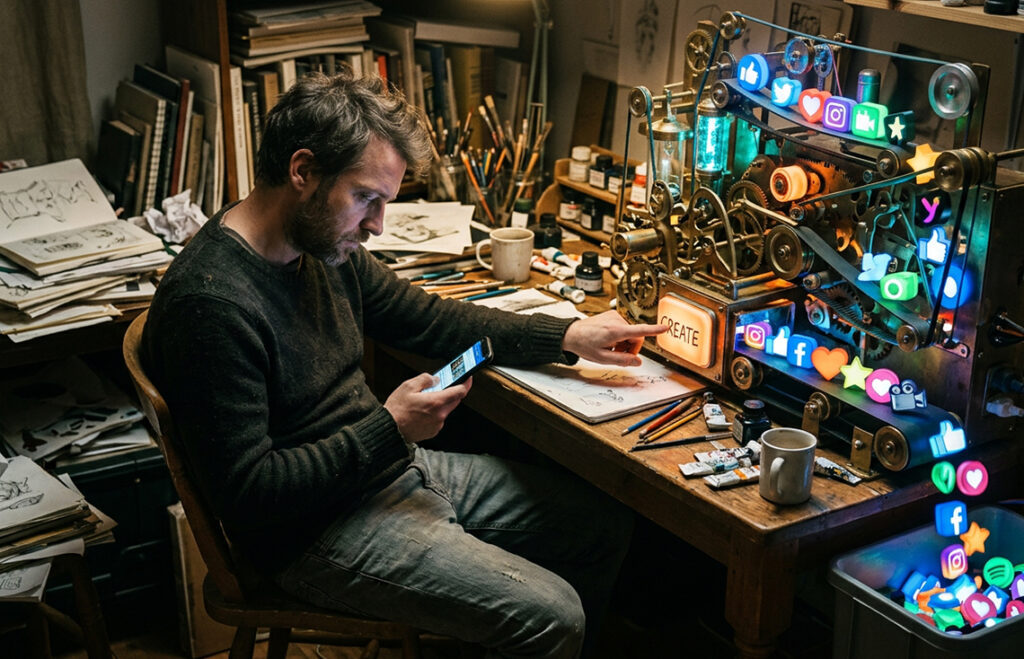
The promise of Artificial Intelligence is intoxicating: lightning-fast execution, endless variation, and the total eradication of the blank page. Today, AI tools can generate an oil painting, draft a marketing campaign, or compose a symphony in a matter of seconds.
Yet, beneath this efficiency lies a quiet, creeping threat. Recent studies reveal a troubling psychological paradox: while generative AI expands our absolute output, it can actively diminish our internal sense of creative agency. Research shows that people often feel less creative when relying heavily on algorithmic assistance.
Furthermore, research and reviews warns of a broader structural danger: the homogenization trap. When individuals use the same predictive text models and image generators, their collective output begins to converge. AI collapses individual eccentricity into a polished, mathematically optimized average.
To remain truly original, we must resist lazy automation. We cannot let AI kill the messy, unpredictable magic of human innovation. Here is how to fight back and protect your creative soul.
1. Shift Your Value Upstream
In the pre-AI era, a significant portion of the creative process was consumed by technical execution—the hours spent mastering brush strokes, editing audio tracks, or debugging lines of code. AI has effectively commoditized this execution phase. If anyone can prompt a model to produce a flawless technical output, then flawless execution is no longer a differentiator.
To survive, your creative value must move upstream.
Your worth no longer lives in the speed of your output, but in the depth of your taste, the specificity of your intent, and the boldness of your direction. AI can generate options, but it cannot know why an option matters. True creativity now requires you to act as a rigorous director and curator. Focus your energy on developing a unique philosophical point of view, deeply understanding human emotion, and identifying the underlying themes that a machine—which has never lived, suffered, or loved—cannot comprehend.
2. Guard the Friction of the “First Draft”
One of the greatest dangers of generative AI is that it makes the creative process too easy. It removes the painful, frustrating, yet vital friction of the first draft.
When you sit down with a blank page, the struggle to articulate your thoughts forces your brain to make unexpected, non-linear connections. Neuroscientists note that human creativity involves complex, widespread brain networks firing simultaneously to link disparate memories and emotions.
When you hand the first draft over to AI, you bypass this cognitive workout. You trade deep, subterranean incubation for cheap convenience. If a machine builds the foundation of your essay, painting, or strategy, you are permanently trapped within the boundaries of its initial assumptions.
The Fix: Establish a strict boundary. Do your messy brainstorming, your initial free-writing, and your rough sketching completely offline. Suffer through the discomfort of the blank page. Use AI only after you have established a concrete, unshakeable human foundation.
3. Treat AI as an Eccentric Instrument, Not an Answer Engine
Most people use AI as a vending machine: insert a prompt, receive a finished product. This transactional relationship kills original thought because it positions the AI as the creator and the human as a passive consumer.
Instead, treat AI as a highly volatile, eccentric musical instrument.
When a musician plays an instrument, they do not just press a button and walk away; they interact with it, push its boundaries, and leverage its quirks. Use AI to create friction rather than eliminate it. Give it intentionally confusing prompts. Force it to combine radically unrelated concepts. Take its output, intentionally break it apart, rearrange the pieces manually, and feed it back into the loop.
Your goal should not be to get a polished final answer from the machine, but to use its statistical hallucinations as a springboard for your own unexpected tangents.
4. Feed Your Mind Analog Raw Materials
AI models are trained on internet data. They are a reflection of what has already been said, done, and uploaded. If you feed your mind the same digital diet as everyone else, and then use the same AI tools as everyone else, your creative output will inevitably become a duplicate of a duplicate.
To output unique ideas, you must ingest unique inputs. You must deliberately seek out analog and non-algorithmic experiences:
- Read physical, out-of-print books that haven’t been scanned into LLM training sets.
- Spend time in silence, away from notification loops, allowing your mind to wander into boredom.
- Observe the physical world—the specific texture of peeling paint on a local building, or the exact cadence of a stranger’s laughter.
These sensory, hyper-local, lived human experiences provide a rich tapestry of context that an AI can never access. They are your ultimate creative unfair advantage.
5. Embrace the Power of Imperfection
AI excels at symmetry, grammar, and standard formatting. It creates outputs that are mathematically “correct” and profoundly safe. But great art and disruptive business ideas rarely come from safety. They come from asymmetry, vulnerability, and beautiful mistakes.
The history of human innovation is a history of happy accidents. A misplaced stroke of paint can give a portrait its haunting depth; a stray guitar frequency can define the sound of a generation. AI does not make accidents; it makes calculations.
Do not let the sleek perfection of AI outputs shame you into hiding your rough edges. Lean into your idiosyncrasies. Write the sentence that violates standard corporate rhythm but feels deeply honest. Leave the raw, unpolished elements in your design. It is precisely within those human imperfections that your unique creative voice resides.
The Future Belongs to the Resistant Creator
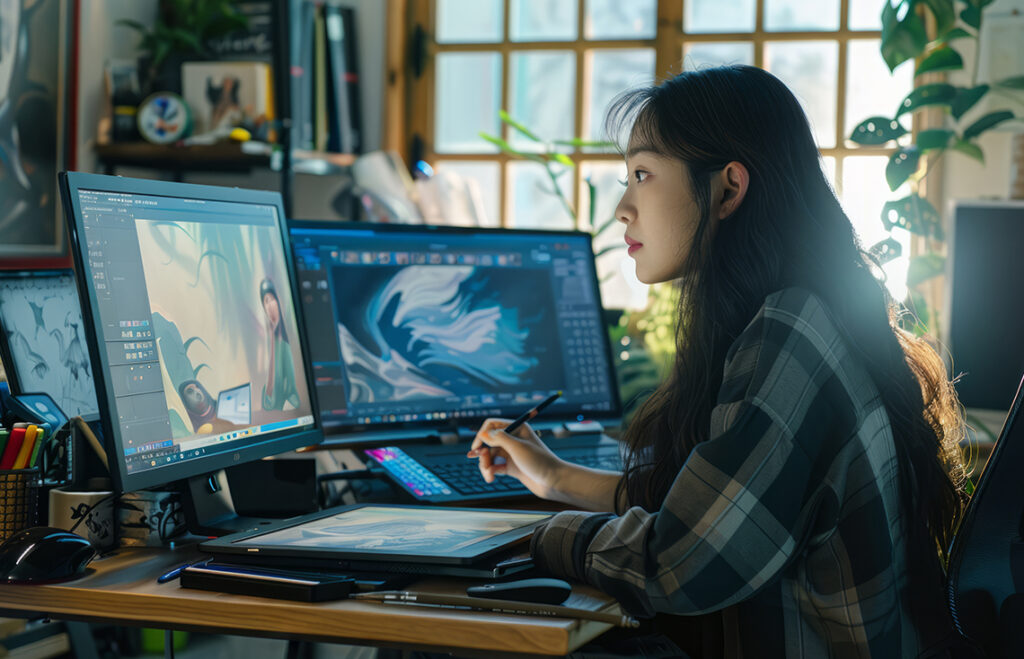
AI is not going away, and resisting it through total avoidance is a losing strategy. The tools will become faster, more immersive, and increasingly persuasive.
But efficiency is not the metric of a meaningful life, nor is it the metric of groundbreaking creativity. If we delegate our thinking, our writing, and our visualizing entirely to algorithms, we will find ourselves living in a culturally stagnant world of smooth, forgettable averages.
The ultimate act of creative rebellion is to refuse to let the machine do your feeling for you. Use AI to handle the mundane logistics, to clear away administrative clutter, or to act as a chaotic sounding board. But when it comes to the core of your work—the spark of human empathy, the willingness to be vulnerable, and the courage to make a mess—keep your hands firmly on the wheel.
Your creativity is not an optimization problem to be solved. It is an wild, irregular human gift to be protected.